

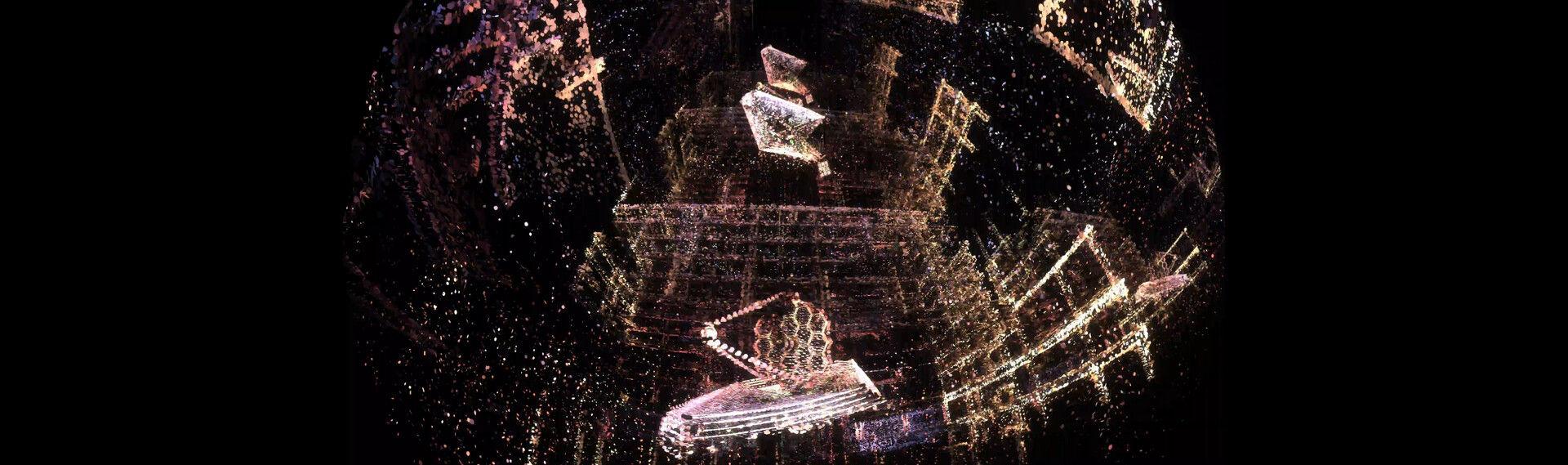
Belief, whether in science or religion, functions as a cornerstone of human experience, weaving together our understanding of existence with a profound willingness to embrace the unknown. The fulldome short film Belief offers a striking meditation on this inherent duality, presenting a visual and auditory journey that challenges viewers to reconsider the nature of conviction itself. This artistic endeavor, blending cutting-edge technology with age-old philosophical inquiry, exemplifies how immersive media can stimulate deep reflection on the impulses that drive human discovery and faith alike.
The film’s premise—that “the pursuit of science and religion both requires a genuine will to believe”—poses a compelling argument that belief is not confined to blind faith or empirical evidence alone, but rather a dynamic interplay between perception, interpretation, and trust. The use of “a custom particle-system inside TouchDesigner” alongside “laser-scans and the AT-HYG star catalog” signals a deliberate fusion of tangible data with imaginative projection, underscoring how technology mediates our relationship with reality and meaning. This intersection is emblematic of a broader trend in fulldome and immersive media, where creators harness both scientific accuracy and artistic vision to evoke emotional and intellectual engagement. Projects like the MindSpace anthology at HAW University mark an exciting frontier, inviting audiences to experience complex themes from new spatial and sensory perspectives.
Such works sit within a larger movement of immersive experiences that challenge traditional storytelling frameworks by enveloping viewers in environments that demand active contemplation rather than passive consumption. For instance, fulldome theaters and planetariums have long been spaces where science education and wonder dovetail, but contemporary artists and designers increasingly leverage these venues for philosophical and existential exploration. The spatial sound design in Belief not only “sets the tone and orients the viewer in space,” but also accentuates how multisensory immersion can shape understanding and feeling, blurring boundaries between observer and subject. These innovations mirror wider industry shifts toward experiential engagement, seen in VR installations, mixed reality art, and interactive theater, where belief is as much about the participant’s internal journey as the external narrative.
The significance of this approach extends well beyond artistic novelty. In a world steeped in polarized views on science, spirituality, and truth, immersive media like Belief offer fertile ground for dialogue and empathy. They underscore that belief—rooted in hope, curiosity, and the search for meaning—is a universal human condition cutting across disciplines and dogmas. The implications for creators and venues are profound: immersive technologies compel us to rethink how narratives are constructed, who participates in meaning-making, and how communal experiences can foster nuanced perspectives. Audiences, increasingly habituated to digital interactivity, crave engagement that challenges their assumptions and expands their cognitive horizons, making fulldome and related media a critical arena for future innovation and cultural discourse.
Yet, this opportunity also demands responsibility. As immersive media grow more sophisticated, the challenge will be to maintain authenticity and respect for the complex phenomena they explore. Creators must navigate the delicate balance between evoking awe and avoiding oversimplification, between letting technology enhance interpretation and overshadow human insight. Venues and programmers should curate experiences that encourage reflective questioning rather than passive spectacle, nurturing environments where belief—scientific or spiritual—can be thoughtfully examined and appreciated.
Moving forward, the fulldome and immersive media community might consider: How can we design experiences that honor the nuanced interplay of skepticism and faith intrinsic to human belief? In what ways can technology be wielded not merely as a tool for visualization, but as a medium for philosophical inquiry and social connection? Engaging with these questions can transform fulldome art from a niche spectacle into a pivotal platform for cultural exchange and intellectual exploration, proving that belief—both a personal and collective act—deserves to be at the heart of our creative imaginations.
Originally sparked by reporting from Máté Bredán via www.fddb.org on 2026-03-11 00:51:00.
Explore the original article here: www.fddb.org