

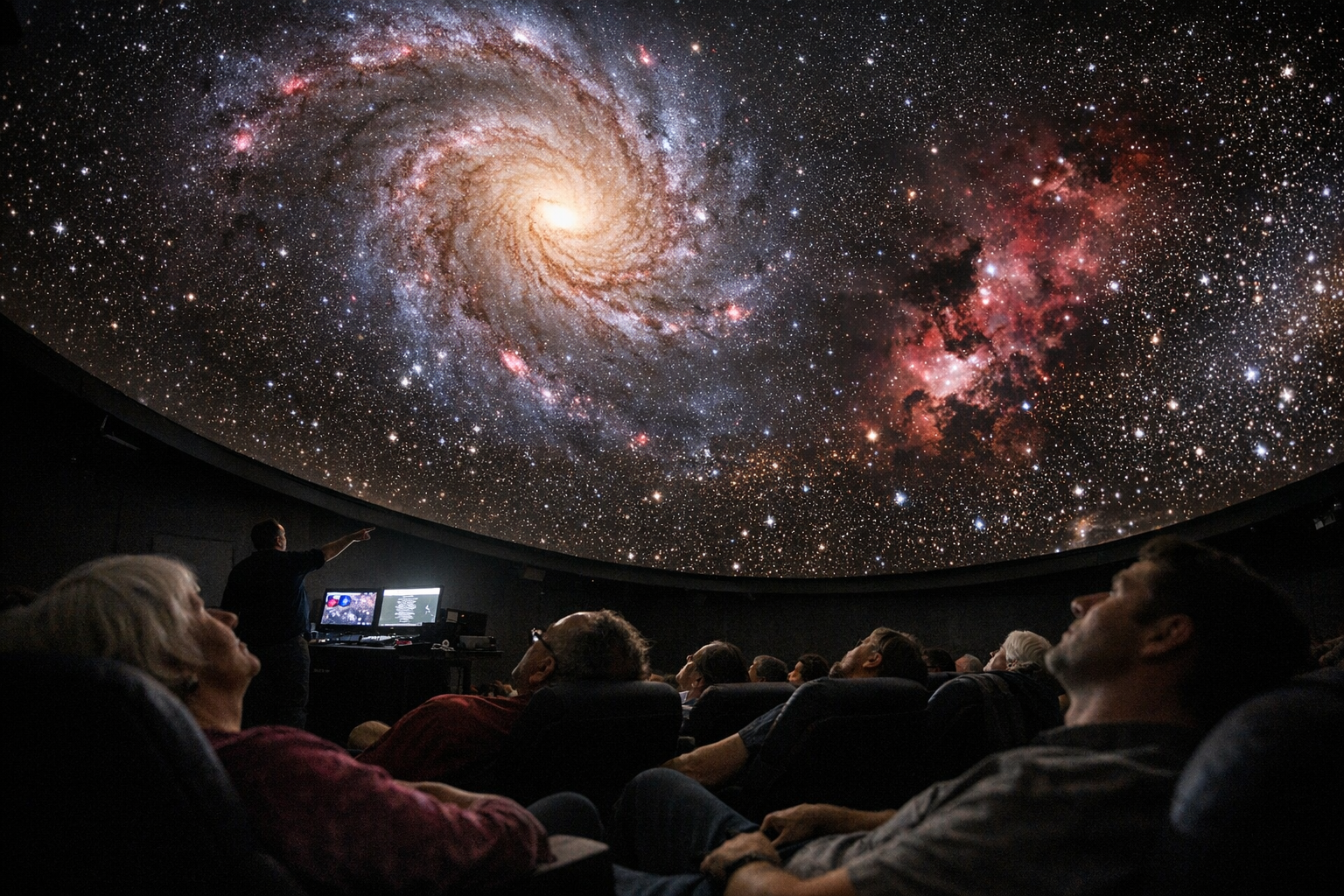
The Pajarito Environmental Education Center (PEEC) in Los Alamos has brought a stunning new immersive educational experience to the local community through the Los Alamos Nature Center Planetarium. On January 15, residents were treated to the first images from the Vera Rubin Observatory, projected in a full-dome format that offered a sweeping and captivating preview of the observatory’s ambitious Legacy Survey of Space and Time (LSST). Beyond being a visually dazzling event, this initiative underscores a deeper mission: to advance public engagement with leading-edge science, inspire STEM learning, and foster a science-literate community. The planetarium show, offered at accessible ticket prices and recommended for children aged eight and above, serves as both an educational platform and a bridge connecting local audiences to a global scientific endeavor.
The show focused on how the Vera Rubin Observatory, equipped with the largest camera ever built, will map billions of galaxies and track near-Earth objects throughout its decade-long survey. As articulated in the program, “For local audiences, the presentation translated distant, data-driven astronomy into a tangible experience: full-sky projections of early Vera Rubin images and an overview of how time-domain surveys detect changing objects across the sky.” This statement highlights the project’s success in making complex scientific data comprehensible and engaging for a community audience, leveraging immersive technology to transform abstract concepts into vivid, relatable experiences. Furthermore, the program serves practical purposes beyond spectacle, reinforcing STEM outreach that complements local school curricula and after-school programs in Los Alamos—a community deeply rooted in scientific culture and research.
This local initiative aligns closely with broader educational goals by breaking down barriers to access and fostering early interest in science among families and school-aged children. As noted, “At modest ticket prices, the show lowered barriers for families and school-aged children to engage with cutting-edge science, reinforcing STEM outreach that complements local school curricula and after-school programs.” By integrating real-world scientific data and imagery into an engaging planetarium setting, the program not only supports formal education standards such as NGSS (Next Generation Science Standards) and STEAM principles, but also promotes inclusivity and hands-on learning opportunities. Additionally, the availability of LSST’s massive public datasets opens avenues for educators and citizen scientists to build innovative, community-centered projects that extend the learning experience beyond a single planetarium visit.
The impact of this fulldome experience extends into educational, economic, and community realms. For the Nature Center and PEEC, ticket revenue helps sustain ongoing programming while attracting visitors who contribute to the local economy. More importantly, the program stimulates ongoing interest and literacy in astronomy and related sciences, as “these public data streams to build hands-on projects and community events” effectively deepen community engagement with scientific discovery. These kinds of immersive experiences are powerful tools for community empowerment, offering residents of all ages a chance to connect with global scientific research in a meaningful and locally relevant way. The project’s success suggests potential for replication or adaptation in other communities with similar scientific and educational goals.
Within the broader fulldome education landscape, the Pajarito Environmental Education Center’s initiative stands as a compelling example of how immersive media can be harnessed to democratize access to frontier science. By translating state-of-the-art astronomical research into accessible visual experiences, the project not only enriches local educational ecosystems but also pushes innovation in planetarium programming and public science engagement. Its ability to weave real-time astronomy data with community outreach mirrors a growing trend in the fulldome field towards interactive, data-driven content that extends beyond passive viewing. This model could inspire other planetariums and environmental centers to incorporate live scientific data streams and foster collaborations that amplify the educational impact of fulldome shows.
As the Vera Rubin Observatory progresses in its survey operations and releases more extensive datasets, the Pajarito Plateau community can anticipate a steady stream of opportunities to engage with cutting-edge astronomy. This initiative thus exemplifies a promising approach to immersive education—one that blends global research with local relevance, builds inclusive learning environments, and galvanizes a community’s connection to the cosmos. Through programs like this, the fulldome field continues to evolve, inspiring deeper curiosity and cultivating the next generation of science enthusiasts and researchers.
Originally reported by via www.prismedia.ai on 2026-01-16 00:00:00.
Read the full original article here: www.prismedia.ai