

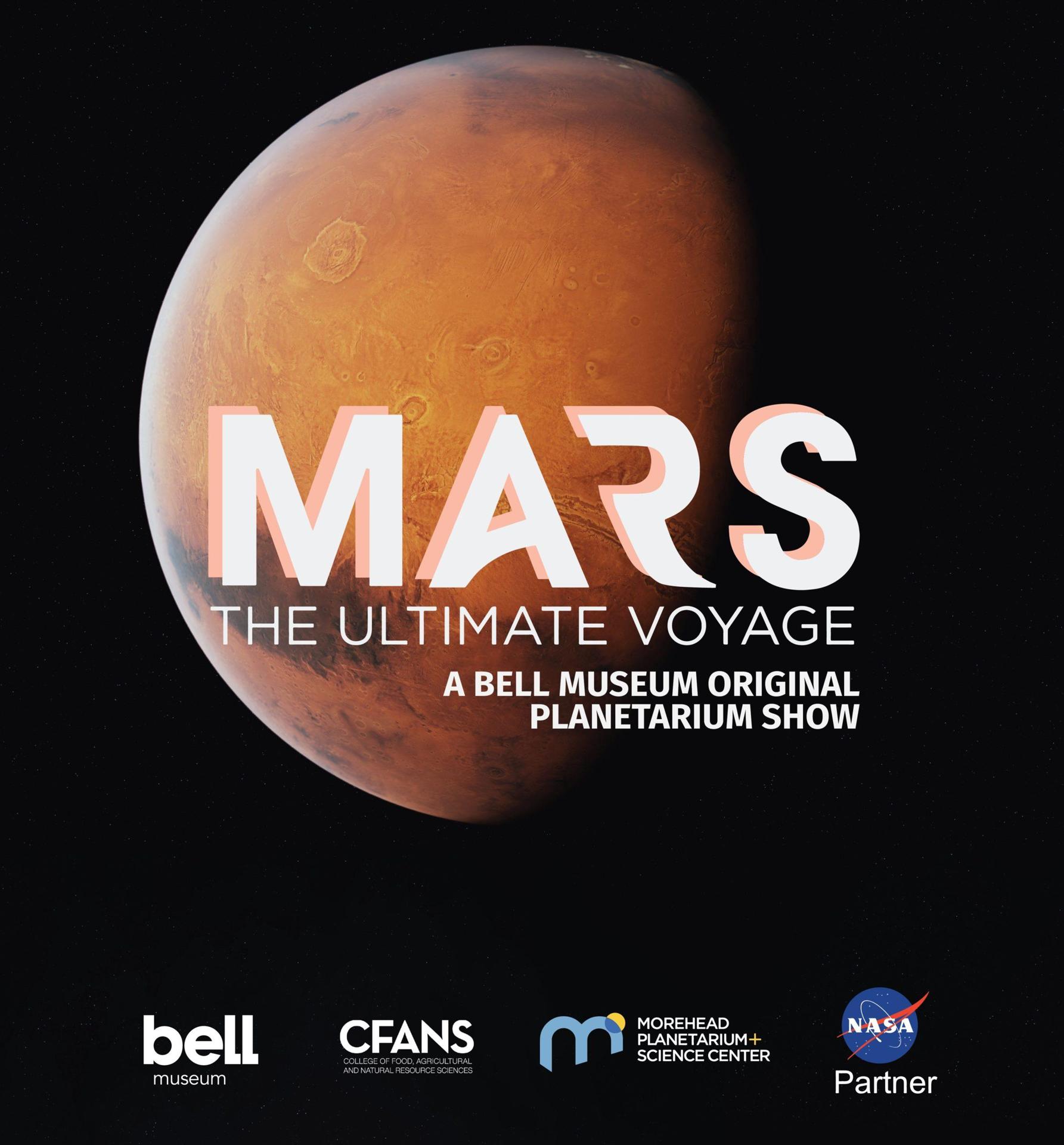
A New Odyssey in Immersive Space Exploration: "Mars: The Ultimate Voyage" Planetarium Show
Space exploration has always captivated humanity’s imagination, but the challenge of journeying to the Moon, Mars, and beyond brings up questions about the technology, human endurance, and the future of interplanetary travel. Addressing these questions through immersive experience, the Bell Museum has launched an original planetarium show titled Mars: The Ultimate Voyage. This new production invites audiences to embark on a simulated voyage, exploring not just the mechanics of space travel but the mental and physical challenges astronauts face far from Earth.
Funded by the NASA Teams Engaging Affiliated Museums and Informal Institutions (TEAM II) Award, this show was developed to deepen public engagement with space science and exploration through state-of-the-art planetarium technology. Created under the Regents of the University of Minnesota, Mars: The Ultimate Voyage is designed to inspire curiosity and convey cutting-edge scientific insights in an entertaining and educational format. The timing is apt as interest in Mars missions intensifies globally, making the show not just an entertainment vehicle but an educational tool supporting STEM outreach.
According to the Bell Museum, Mars: The Ultimate Voyage invites visitors to ponder, “Ever wondered what it will take for astronauts to travel to the Moon, Mars and beyond? On this long journey, what challenges will astronauts face?” The show offers an immersive journey into these very aspects of space travel, reflecting on human endurance, psychological resilience, and technological innovation required on such missions. It also addresses motivation and health maintenance for astronauts so far distant from Earth, integrating narratives that connect audiences emotionally and intellectually to these explorers’ experiences.
What stands out about this production is the blend of scientific accuracy with immersive storytelling. The Bell Museum explains the show “explores these questions and more,” suggesting a broad scope that combines factual scientific content with the dynamic visual and auditory power of planetarium technology. This approach positions the planetarium show not merely as a passive viewing experience but as an engaging narrative journey that educates while it entertains.
Technologically, the innovation behind Mars: The Ultimate Voyage lies in leveraging advanced planetarium projection systems capable of rendering high-resolution, full-dome visuals that envelop the viewer. Although the source does not specify technical details, state-of-the-art planetarium productions typically utilize sophisticated rendering pipelines that support real-time or pre-rendered 360-degree animations, often enriched with spatial audio designs to create a fully immersive environment. These systems can integrate data from NASA missions, simulated XR environments, and other digital assets to produce scientifically credible and visually compelling experiences.
The collaboration between a research institution and a museum under a NASA grant highlights how such productions benefit from interdisciplinary expertise, combining astronomical science, computer graphics, storytelling, and sound engineering. By pushing the boundaries of dome master workflows and possibly employing AI or advanced rendering techniques, productions like this can set new standards in the fulldome industry for realism and interactive potential. Such technologies enhance the capacity to bring space environments, with their unique lighting and physics, into educational settings for broad audiences.
For the fulldome industry, Mars: The Ultimate Voyage exemplifies how immersive media can evolve to take advantage of deeper funding sources and partnerships with scientific agencies. This kind of support can encourage more ambitious content creation, blending scientific rigor with artistic creativity. Educators and creators benefit from having access to relevant, timely content that aligns with current space exploration initiatives, making the planetarium not only a site of wonder but also a platform for education aligned with national and global science priorities.
Adoption challenges may remain, such as the need for hardware upgrades to support the highest resolution and real-time capabilities, or the resources required for developing such detailed shows. However, projects backed by NASA and academic collaborations demonstrate viable models for pushing the medium forward while maintaining educational integrity. As audiences increasingly expect immersive, interactive learning experiences, productions like Mars: The Ultimate Voyage can influence the future direction of fulldome content—making space science accessible, exciting, and relevant.
In sum, Mars: The Ultimate Voyage is more than a planetarium show; it is a technological and narrative milestone that highlights the evolution of immersive education in space science. By combining scientific insights with immersive storytelling, it opens new pathways for how audiences can experience and understand the challenges and marvels of interplanetary travel. As fulldome technology continues to advance, innovations like this will play a key role in expanding the boundaries of what such immersive media can achieve.
Originally reported by Bell Museum via www.fddb.org on 2025-12-11 12:05:00.
Read the full original article here: www.fddb.org