

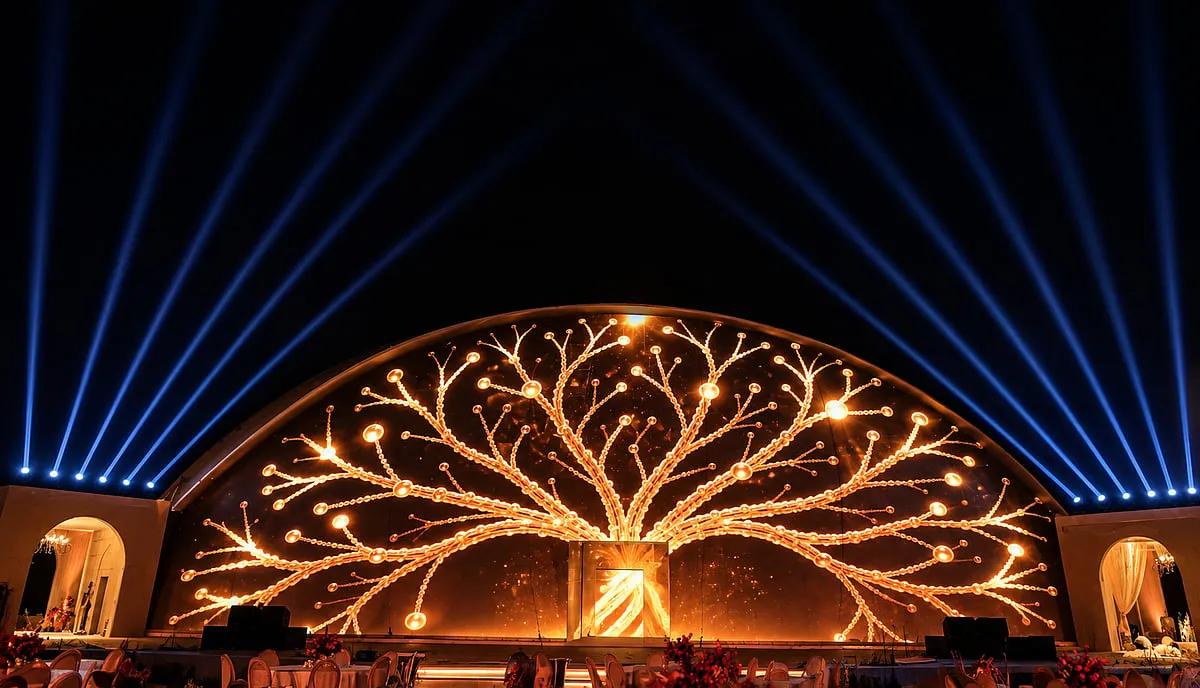

As cities compete to offer experiences that feel less like venues and more like worlds, immersive architecture is becoming a serious business story. In India, that shift is especially visible in travel and events, where destination weddings, brand launches, and live entertainment are increasingly built around spectacle as much as logistics. Outlook Traveller has recently reported on SkyDome’s Jaipur debut as a large-format immersive event space, alongside a broader wave of experimental venues and dome-based attractions that blur the line between hospitality, cinema, and design. (outlooktraveller.com)
That context matters because India’s events market is no longer defined only by capacity or location. It is being shaped by audience expectations: more personalization, more visual drama, and more reasons to travel for an occasion rather than simply attend it. Jaipur, with its heritage hotels and destination wedding economy, has become a natural testing ground for that evolution. SkyDome’s arrival fits into a wider trend where venues are trying to function as content platforms, not just rental spaces. (outlooktraveller.com)
“India’s tourism and live-events sectors present a significant business opportunity for destinations looking to attract more visitors and diversify their offerings,” Sachin Mutreja told Outlook Traveller’s Tenzin Chodon at outlooktraveller.com. The line is revealing because it frames immersive infrastructure as an economic lever, not merely an aesthetic one. In that sense, SkyDome is part of a broader commercial recalibration: cities are competing to host experiences that can pull in spending across hotels, transport, production, and ancillary services. (outlooktraveller.com)
What makes this particularly interesting is that immersive venues are increasingly cross-pollinating with other sectors. A dome that can host a wedding one week and a branded experience the next is also a sign of how technology is reshaping spatial design. The emphasis is less on fixed format and more on adaptability—projection, lighting, acoustics, and environmental control become the raw materials of a custom-built atmosphere. That is a powerful proposition for planners looking to differentiate events in crowded markets. (outlooktraveller.com)
“Instead of designing an event around a fixed stage or screen, the dome allows organisers to transform the surrounding environment itself,” Sumit Chandhoke told Outlook Traveller’s Tenzin Chodon at outlooktraveller.com. The idea is important because it captures a shift in how audiences consume live experiences: the room itself becomes part of the performance. For planners and brands, that means the venue is no longer a passive container but an active storytelling tool. (outlooktraveller.com)
That approach also helps explain why immersive venues are finding traction beyond traditional entertainment districts. In a market where event budgets are scrutinized, a space that delivers built-in visual impact can reduce the need for elaborate temporary fabrication while still producing a memorable guest experience. At the same time, these formats raise the bar for production quality; a dramatic shell only works if the programming inside it is equally strong. (outlooktraveller.com)
Sonalika Sengupta’s framing of the project as something that can expand “what Jaipur can host” points to another layer of the story: regional diversification. Rather than concentrating premium experiences only in metros, immersive event infrastructure is moving into cities with existing tourism appeal and strong hospitality ecosystems. That matters for how travelers, couples, and corporate clients choose destinations, especially when the venue itself becomes part of the draw. (outlooktraveller.com)
The fulldome connection here is direct. SkyDome belongs to the same broader family of immersive dome environments that are changing how people experience projection, scale, and shared spectacle. While it is not a planetarium, the architecture and 360-degree visual logic overlap with fulldome and dome cinema concepts, making it relevant to the evolving ecosystem of large-format immersive spaces. (outlooktraveller.com)
Originally reported by Outlook Traveller via www.outlooktraveller.com on 2026-11-24 22:17:00.
Read the full original article here: www.outlooktraveller.com