


Trend Overview
The immersive media sector is increasingly defined by a move from “more spectacle” to “more situational design.” Across venues, creators are no longer just asking how to make an attraction bigger or louder; they are asking how to make it fit a specific building, a specific climate, and a specific audience expectation. That shift is visible in everything from modular dome installations and projection-mapped pop-ups to mixed-format attractions that can flex between permanent and temporary use.
A useful signal comes from adjacent experience industries, where classic formats are being reworked for new operating constraints. The same logic is now shaping immersive content distribution: the winning products are often the ones that preserve a familiar core while adapting to new environments. In practice, that means creators and venues are prioritizing portability, year-round reliability, and a stronger sense of enclosure or immersion, all while keeping footprint and operational complexity under control.
Supporting Voices & Signals
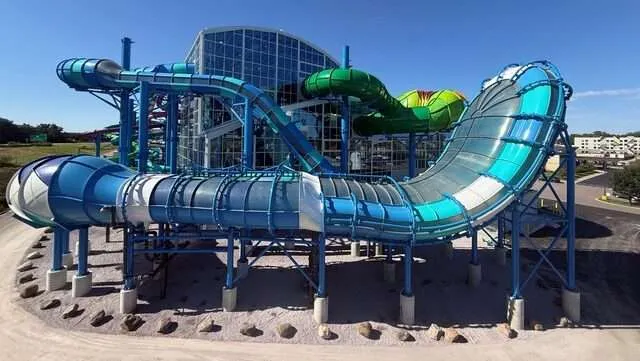
WhiteWater framed the new installation as a reinterpretation rather than a reinvention, saying it “completely reimagining[s] the ride experience.” That distinction matters for the immersive content world, too. The most commercially resilient experiences are often not the most experimental in absolute terms, but the ones that translate a proven format into a fresh context without losing audience trust.
The company also emphasized that the new design “allows this imposing feature to be utilized for indoor waterparks, without taking up expensive indoor footprint.” For fulldome producers and venue operators, the parallel is clear: spatial efficiency is becoming a competitive advantage. As institutions work with tighter budgets and rising operating costs, the ability to stage premium experiences in compact or unconventional footprints is increasingly valuable. In the dome world, that translates into flexible installs, reusable content packages, and productions that can scale across different venue sizes.
Another quote points to the broader strategic opportunity: “The concept goes well beyond indoor waterparks; it could be an outstanding headline attraction for outdoor parks as well.” That kind of cross-environment adaptability is exactly what content distributors are chasing in immersive media. A show that can travel between science centers, planetariums, festivals, and pop-up domes has a stronger commercial life than a title designed for one room and one audience only. We are seeing more emphasis on format-agnostic programming, where the same IP can be localized, re-skinned, or technically adjusted for multiple venue types.
Distribution Insights
For fulldome content, this trend is expanding the role of touring and hybrid distribution. Touring domes remain important because they lower the barrier to entry for venues that lack permanent infrastructure, while also giving creators a way to reach audiences in nontraditional settings. At the same time, hybrid presentation models are becoming more common: a work may debut in a flagship venue, then move into a touring package, and later be licensed to smaller institutions through a regional distributor or a platform-based catalog.
That matters because the market is fragmenting in a healthy way. Rather than depending entirely on a small number of legacy planetariums or museum clients, creators can now pursue multiple routes to audience. Festivals still serve as discovery engines, but they increasingly function as launchpads for licensing rather than the endpoint of a work’s lifecycle. For producers, that means thinking about distribution earlier in the creative process: runtime, technical specs, language versions, and modularity can determine whether a piece travels widely or stays local.
Audience behavior is also evolving. Immersive consumers are becoming more comfortable encountering content in mixed contexts — at a museum one week, a special event the next, and a branded or seasonal activation after that. That flexibility rewards creators who can package content for both cultural credibility and commercial portability. In other words, the strongest distribution strategy may no longer be a single premium booking pathway, but a layered release plan that includes touring domes, institutional licensing, festival exposure, and venue partnerships.
Industry Implications
For producers, the message is to design with distribution in mind from day one. That means building content that can survive changes in screen geometry, room scale, and technical setup, while still delivering a distinctive emotional payoff. The more a work can adapt without feeling diluted, the more valuable it becomes to buyers.
For curators and institutions, the challenge is to balance novelty with operational realism. Venues will increasingly favor experiences that are not only immersive, but dependable, installable, and easy to refresh seasonally. The opportunity is significant: as the line between permanent attraction and portable content continues to blur, the immersive media industry may find new audiences in places that were previously too constrained, too seasonal, or too expensive to serve.
Originally reported by IPM News via www.inparkmagazine.com on 2026-10-20 18:49:00.
Read the full original article here: www.inparkmagazine.com