

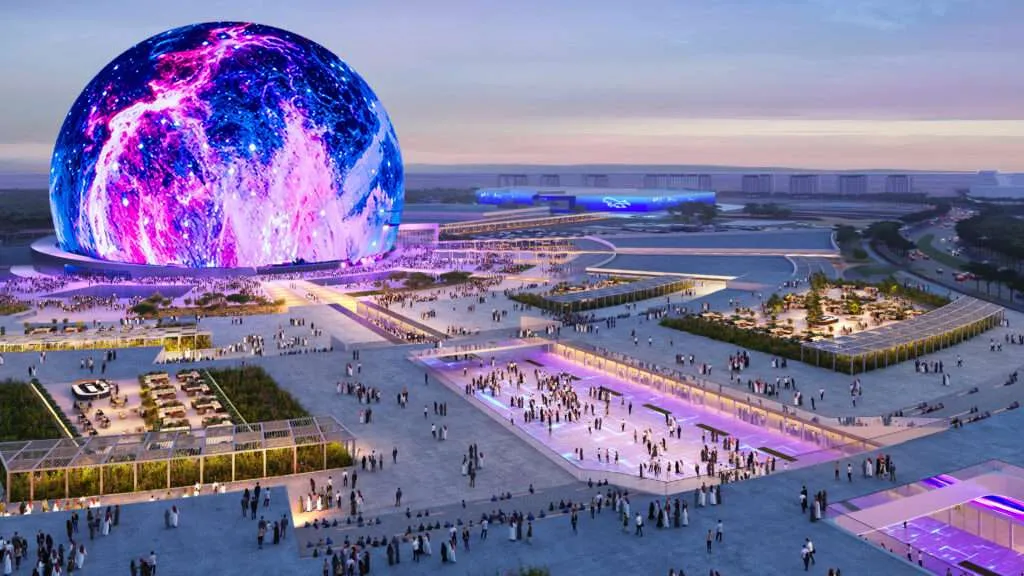

Bigger screens are not the same thing as bigger ideas. That may sound like a contrarian take in an era obsessed with record-breaking façades, but the real story behind projects like Sphere Abu Dhabi is not merely scale. It is the growing conviction that architecture itself can become a media platform — and that the value of a venue will increasingly be measured not just by how many people it holds, but by how powerfully it can communicate, transform, and participate in culture.
That is why the announcement about the Exosphere matters. The article describes it as “a major new platform for celebrating local creative talent,” and that is the most important sentence in the whole release. If an exterior LED system is treated only as a spectacle machine, it risks becoming a very expensive screensaver. But if it is used to stage local art, public storytelling, civic identity, and shared experience, then it becomes something closer to a new urban medium. In that sense, the real innovation is not the hardware. It is the editorial ambition behind it.
The quote that the Exosphere will turn the building into “a digital canvas for art, entertainment and visual storytelling” points to both the promise and the tension of immersive media. On one hand, this is exactly what audiences now expect from landmark venues: not passive consumption, but environments that feel alive and responsive. On the other hand, the more often we use phrases like “immersive” and “multi-sensory,” the more we should ask whether the industry is designing for emotional depth or just for novelty. The difference matters.
We have seen this debate before in fulldome theaters, planetariums, projection-mapped façades, and large-format immersive installations. The strongest work in those spaces does more than surround the viewer; it gives them a reason to care. Think of fulldome programs that merge astronomy, indigenous storytelling, and science education. Or museum projections that use motion and sound to create context rather than just visual excess. The best experiences are not the loudest. They are the ones that align technology with a clear curatorial purpose.
Sphere Abu Dhabi also signals something broader about the creative industries in the Gulf. The region is no longer simply importing spectacle; it is increasingly building the infrastructure, talent base, and technical confidence to originate it. That is a meaningful shift. A project of this magnitude creates work for engineers, integrators, artists, content teams, operators, and local vendors. It also creates expectations. Once a city begins to define itself through programmable media architecture, it will be judged not only by its engineering bravado, but by the quality and intelligence of the content it chooses to present.
That is where the long-term stakes lie. The immersive sector is maturing, and maturity requires more than platform-building. It requires programming discipline, artistic risk, and a sustainable ecosystem for commissioning original work. Venues that commission only brand activations and repetitive spectacle eventually train audiences to expect distraction rather than meaning. Venues that balance commercial use with artistic and cultural programming can become civic assets — places that generate repeat visitation because they evolve intellectually, not just visually.
There is also an important economic argument here. As more destinations invest in iconic media surfaces, the competitive advantage will shift from who has the biggest display to who has the best creative pipeline. The winners will be venues that can attract filmmakers, visual artists, game designers, musicians, and immersive storytellers who know how to exploit the form without being swallowed by it. That requires collaboration between developers, technologists, programmers, and cultural institutions.
So the real question is not whether Sphere Abu Dhabi can be dazzling. Of course it can. The question is whether it can be culturally necessary. Can a façade this monumental become more than a landmark of engineering? Can it become a living platform that reflects place, supports artists, and deepens audience imagination? If the immersive industry is serious about its future, that is the standard it should set for itself.
Originally sparked by reporting from IPM News via www.inparkmagazine.com on 2026-10-20 19:03:00.
Explore the original article here: www.inparkmagazine.com