

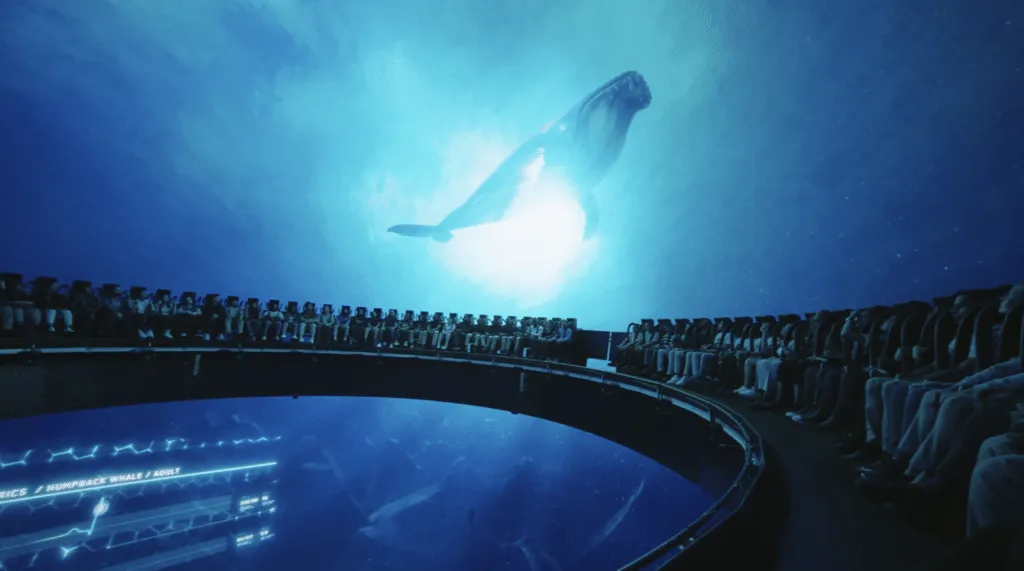

The real innovation in immersive entertainment is not the technology. It is the discipline to make technology disappear.
That may sound counterintuitive in an industry that often celebrates bigger LED volumes, more sensors, more motion axes, and ever-more elaborate special effects. But the strongest experiences today are not necessarily the most technically ambitious; they are the ones that translate complexity into clarity for the guest. Markus Beyr’s career, as reflected in the source article, is a useful reminder that the future of attractions will not be won by spectacle alone. It will be won by systems that can reliably create emotion, repeatability, and commercial viability at the same time.
Beyr puts it plainly when he says, “the symbiosis of concept, content and technology” is what fascinates him most. That’s the right emphasis. Too many projects still begin with a gadget and work backward toward a story. The result is often impressive for a demo and underwhelming for a season. By contrast, the most durable immersive formats — from motion theaters to projection-based dark rides to fulldome science venues — succeed when they are designed as complete experiences, not as proof-of-concept hardware. The guest does not buy a platform; the guest buys surprise, delight, escape, and memory.
His other line is equally revealing: “We don’t like to stop being innovative.” In one sense, that is admirable; in another, it is the industry’s trap. Innovation becomes meaningless if it is treated as a permanent acceleration rather than a strategic choice. Not every venue needs a new format, and not every audience wants one. What they do want is something that feels coherent, accessible, and worth returning to. That is why the best immersive operators think less like inventors and more like editors: they choose what to remove, what to simplify, and what to make legible.
That distinction matters across the creative industries. In fulldome, for instance, the venues that thrive are rarely the ones with the most technical bravado; they are the ones that combine strong programming, educational relevance, and a dependable audience proposition. The same is true in location-based entertainment, where hybrids of motion, media, and interactivity can either create a compelling all-ages destination or collapse into expensive novelty. The difference is usually not the hardware. It is the quality of integration, narrative pacing, and operator confidence.
We are also seeing a market shift toward formats that are modular, scalable, and adaptable to different footprints. That is a smart response to real-world conditions: rising build costs, limited space, uneven demand, and the need to justify capex with broad audience appeal. Beyr’s emphasis on making ideas “technically achievable and suitable for an operating venue” speaks to a larger truth: creative ambition only becomes sustainable when it can live within operational reality. The next generation of immersive attractions will likely be judged less by how groundbreaking they look on opening day and more by whether they can survive staffing constraints, refresh cycles, and changing visitor expectations.
This is especially important for venues trying to differentiate themselves in a crowded market. Consumers are becoming more media literate and less easily dazzled by surface effects. They recognize when an experience has no inner logic. They also recognize when a space has been built with care, where every element — sound, motion, content, lighting, queueing, and post-show flow — contributes to a larger emotional arc. That is where companies like Attraktion! are pointing the conversation: not toward louder entertainment, but toward better-structured entertainment.
So the question for the industry is not, “What can we make next?” It is, “What should we make next, and who can actually sustain it?” Creators, programmers, and vendors would do well to shift from a culture of technological one-upmanship to one of guest-centered utility. If a concept cannot be explained clearly, operated efficiently, and refreshed over time, it is not innovative enough — no matter how futuristic it looks on a render.
The most provocative idea in Beyr’s story may be this: the future belongs to those who can wait for the market to catch up. In an industry obsessed with being first, maybe the smarter ambition is being right.
Originally sparked by reporting from Becci Knowles via www.inparkmagazine.com on 2026-10-25 21:51:00.
Explore the original article here: www.inparkmagazine.com