

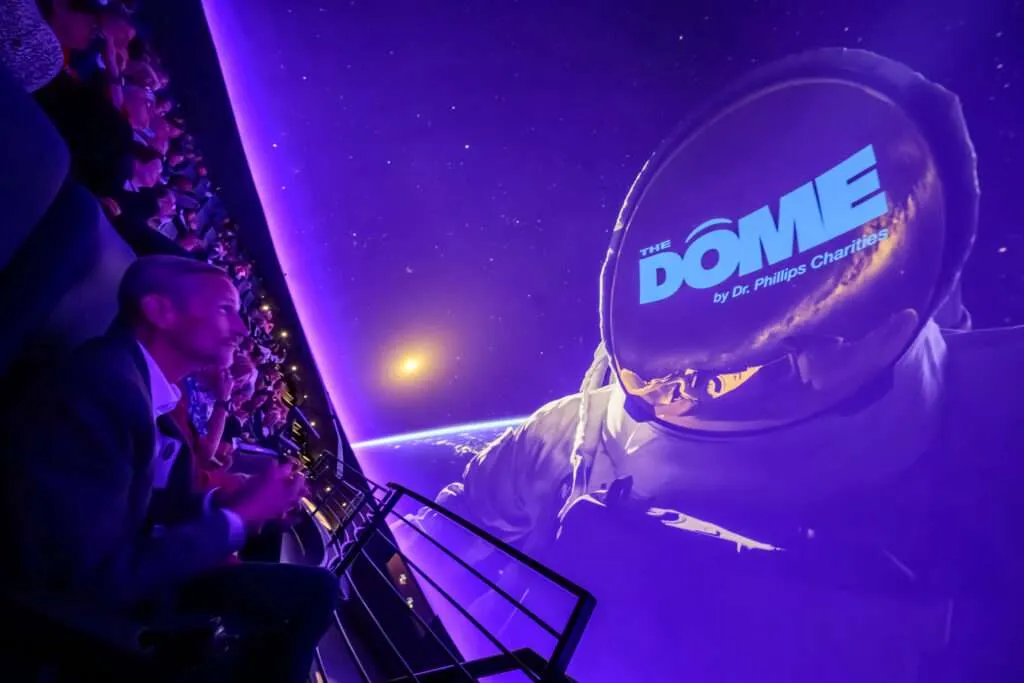

Immersive venues are entering a new phase: not just upgrading projection, but rethinking what a dome can be. The Orlando Science Center’s renovation of its longtime giant-screen theater into a flexible digital fulldome venue reflects a broader shift across the planetarium and immersive media sector. Institutions that once relied on a single-purpose film format are now investing in systems that can support astronomy shows, science visualizations, live events, laser programming, and cinematic releases in one space. The result is a venue model that is less about preservation alone and more about programming agility, audience retention, and year-round revenue potential.
That shift is being driven by both audience expectations and technology maturity. Visitors increasingly expect media environments to feel contemporary, responsive, and immersive at a level that rivals premium themed entertainment. At the same time, projection, show control, and content pipelines have matured enough that operators can now build domes that are more adaptable than the legacy systems they replace. Orlando’s upgrade is especially notable because it did not simply “modernize” the room; it redefined the theater as a multi-use platform with scientific, educational, and entertainment value.
A key signal from the Orlando project is how closely venue strategy, technical integration, and content ambitions now intersect. As OSC president and CEO JoAnn Newman put it, “The Dome is a step forward in how we present storytelling that educates and inspires contemporary audiences.” That framing is important: the investment is not just about sharper images, but about keeping the institution relevant to how audiences consume media now. The venue’s ability to show both giant-screen features and fulldome science content, while also supporting laser shows and live performance, reflects a growing industry preference for mixed-format utility over rigid specialization.
The project also shows how much value now sits in expert advisory roles. Paul Fraser, who helped guide the upgrade, said, “My job is to make sure that clients have the best information possible in order to choose what’s right for them.” That is increasingly the role of consultants across the immersive sector: reducing risk, matching technical choices to content goals, and ensuring the venue can evolve. Stephen Holt echoed that operational perspective, noting that Fraser’s guidance supported “long-term value” and helped OSC make informed decisions. In other words, the upgrade is not just a capital project; it is a strategic content infrastructure decision.
The technical choices reinforce the same trend. Christie’s Griffyn RGB laser projectors, SSIA’s control stack, and the new seamless screen surface all point to a market where compatibility, maintainability, and content flexibility matter as much as raw brightness. The dome is now designed to handle pre-rendered productions, real-time visualizations, and traditional cinematic work without requiring a separate facility for each use case. That versatility is becoming a competitive differentiator, particularly for museums and science centers that must justify major capital spending through broader utilization.
For fulldome content distribution, this is an important development. More venues are now capable of showing a wider range of content, which broadens the addressable market for creators beyond a narrow planetarium-only circuit. Touring shows, regional licensing, and hybrid programming models become more attractive when a single venue can host daytime science content, evening entertainment, and special-event programming. That opens the door to longer exhibition life cycles and more varied monetization paths, especially for producers who can package content in multiple lengths, formats, and technical deliverables.
It also suggests that creators may need to think more like distributors. A dome show today may need to travel cleanly across institutions with different screen geometries, projector counts, and automation systems. That increases the value of modular content design, format-agnostic masters, and optional live or interactive components. Festival routes and curator networks remain important discovery channels, but the real growth opportunity may be in venue partnerships that let content live across museum calendars, after-hours events, and special ticketed activations.
The broader implication is that domes are becoming programmable media environments rather than fixed-format theaters. For producers, that means content should be conceived with adaptability in mind. For curators and institutions, it means programming strategy matters as much as hardware selection. And for venues still operating legacy systems, the Orlando case is a reminder that modernization is no longer just about image quality; it is about unlocking new business models, new audiences, and new reasons for people to return.
Originally reported by Joe Kleiman via www.inparkmagazine.com on 2026-10-25 19:25:00.
Read the full original article here: www.inparkmagazine.com