


Immersive Entertainment Enters Its Platform Era
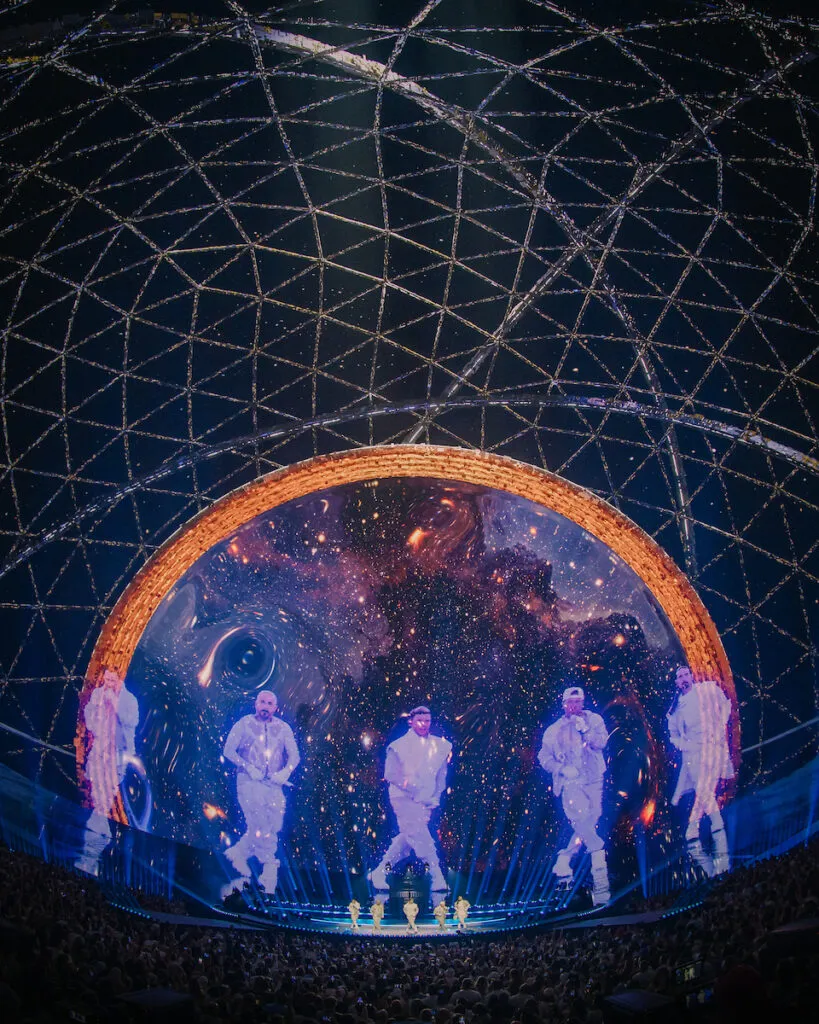
The immersive media sector is moving beyond one-off spectacle and toward a more platform-like model, where venues, technology stacks, and content workflows are being designed for repeatability, scalability, and future expansion. The latest partnership between Sphere Entertainment Co. and Disguise signals that shift clearly: the focus is no longer just on making a single venue look extraordinary, but on building the infrastructure that can support a network of immersive experiences over time.
That matters because the market for large-format, wraparound, and fulldome-style presentation is becoming more competitive and more technically demanding. Audiences now expect high frame-rate motion, lower latency, synchronized playback, and production workflows that can adapt to concerts, corporate events, branded activations, and cinematic content alike. In that environment, the winners are likely to be the venues and vendors that can turn custom innovation into reusable systems.
A key sign of the direction of travel is Sphere’s decision to deepen its relationship with a technology partner it already knows well. As Ryan Dolan, Executive Vice President and Head of Event & Interactive Technology at Sphere, put it: “Sphere was built to redefine live entertainment.” That ambition is not just artistic; it is operational. The venue’s next phase appears to be about extending a proven production model into new venues and new markets, rather than treating every show as a standalone engineering challenge.
Disguise sees the opportunity in equally strategic terms. Fernando Küfer, CEO of Disguise, said the company is focused on “supporting the most incredible entertainment experiences in the world.” He added that “when an artist imagines something the world has never seen, they should be able to reach for it and know the system can deliver.” That framing reflects a wider industry trend: technology partners are increasingly being asked to underwrite creative ambition, not just supply hardware.
Sphere’s announcement also reinforces a broader shift already visible across immersive entertainment and fulldome programming. Venue operators are seeking vendor relationships that can shorten setup time, improve reliability, and create a common technical language across productions. In practice, that means media-server ecosystems, content management pipelines, and synchronized playback systems are becoming as important as LED architecture or audio design. For creators, the implication is clear: content development is increasingly tied to the capabilities of the venue stack itself.
For fulldome distribution, this has important downstream effects. As production systems become more standardized and interoperable, more content can move between venue types: purpose-built megavenues, science centers, planetariums, touring domes, and hybrid event spaces. That expands the addressable market for immersive work, especially for content that can be versioned for different screen geometries and runtime lengths. Creators who design with modularity in mind may find it easier to license the same title across institutional, commercial, and touring circuits.
It also suggests a shift in bargaining power. When venues invest in advanced playback and show-control infrastructure, they may prefer to commission content in formats that fit their proprietary workflows, but the upside is that those same systems can make it easier to tour a show or repurpose assets for future engagements. In other words, control may become more centralized at the venue level even as distribution becomes more flexible at the content level. For independent producers, that creates both a risk and an opportunity: access to premium venues may require closer technical alignment, but it can also open doors to longer-tail monetization.
Festival and exhibition routes remain essential in this ecosystem, but they are no longer the only path to audience reach. Touring domes, branded pop-ups, and corporate event programming are increasingly part of the distribution mix, especially for immersive work that can travel well and generate live revenue. For institutions, that means content strategy may need to become more portfolio-driven: commissioning for exhibition, licensing for touring, and planning for multiple display contexts from the start.
The broader industry implication is that immersive media is becoming less experimental in infrastructure terms, even as it remains highly experimental creatively. Producers may need to think more like systems designers; curators may need to evaluate both narrative impact and technical portability; and venues will have to balance exclusivity with interoperability. If Sphere and Disguise are a sign of where the market is headed, the next competitive frontier in immersive entertainment will not just be spectacle. It will be the ability to scale that spectacle into a repeatable business model.
Originally reported by IPM News via www.inparkmagazine.com on 2026-09-23 09:52:00.
Read the full original article here: www.inparkmagazine.com